On the Dash:
- Simple background tech, like smart ignition, earns higher satisfaction than advanced automation features, JD Power survey finds.
- Hands-free L2+ systems score lower than basic L2 systems despite offering more functionality.
- Passenger screens rank among the most problematic features, and most owners never use them.
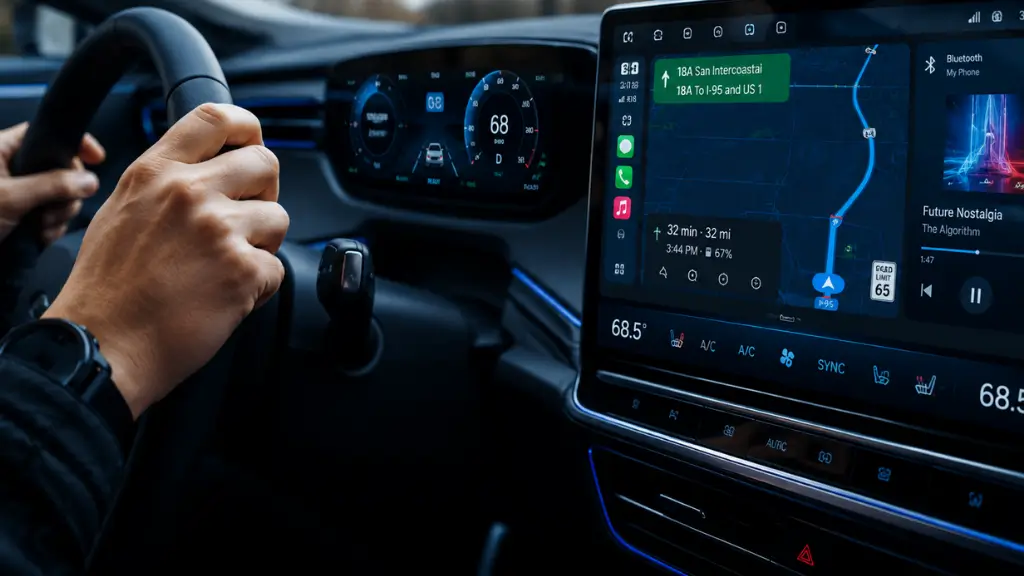
Owners are least satisfied with the technology automakers are betting on most, according to the JD Power 2026 U.S. Tech Experience Index (TXI) Study, released today. Hands-free driving systems and passenger screens rank among the most problematic features in the industry, while simple background tech like smart ignition and climate control earns the highest satisfaction scores.
The study looked at 40 technologies across five categories, such as:
- Comfort and convenience
- Connected vehicle
- Driver assist
- Electric vehicle
- Smart vehicle systems
Results are based on 68,084 owners of new 2026 model-year vehicles surveyed after 90 days of ownership.
Smart tech that goes unnoticed
Features that seamlessly integrate into the driving experience tend to be more satisfying and reliable than flashier upgrades. For example, smart ignition automatically starts and stops the vehicle depending on driver behavior. It scores highest in overall satisfaction and has one of the lowest issue rates in the study, at 2.4 problems per 100 vehicles (PP100). Similarly, smart climate control and driver preference systems are well-regarded, with owners appreciating their functionality and rarely reporting issues.
“The technology customers value most is often the technology they barely notice because it simply works,” said Doron Hikry, Director of Customer Success at JD Power. He reiterated that smart ignition and smart climate control make everyday driving easier without demanding attention and added that automation and extra screens don’t necessarily improve the experience. He said automakers should prioritize technology that simplifies driving rather than complicates it, since features that solve real problems without adding effort are the ones resonating most with customers.
Advanced driver assist systems don’t outperform simpler ones
More features don’t necessarily improve the owner experience of hands-free driving systems. SAE Level 2+ (L2+) allows drivers to take their hands off the wheel in certain situations, although they offer more functionality, L2+ systems perform worse than standard SAE Level 2 (L2) systems in terms of execution and overall user satisfaction. L2+ systems have slightly fewer problems, with 13.8 problems per 100 vehicles (PP100) compared to 14.3 PP100 for L2 systems.
However, this small improvement hasn’t led to higher satisfaction, and simply having hands-free features isn’t convincing drivers. Premium vehicles often include passenger-side screens, but these aren’t very effective. The problem rate for passenger screens is 21.3 PP100, one of the highest among the technologies studied, and most owners rarely or never use them. Over one-third of owners with a passenger screen (35%) have never tried it, and only 6% use it consistently every time they drive. Additionally, JD Power’s 2026 U.S. Initial Quality Study (IQS) found that some vehicles with passenger screens also had higher infotainment problems.
Cadillac & Hyundai lead their segments for innovation
According to the study, Cadillac leads overall and among premium brands in innovation, with a score of 641 out of 1,000. Genesis follows second at 559, and BMW is third at 524. Hyundai remains the top mass-market brand for innovation for the seventh year in a row, scoring 524. GMC and Kia tie for second in this segment, each with 470 points. Additionally, JD Power recognized recipients of the Advanced Technology Award in four out of five study categories this year, excluding the smart vehicle segment.
- Comfort and convenience: Cadillac Escalade (premium) and Toyota Tundra (mass market), both for camera rear-view mirror technology
- Connected vehicle: BMW X6 (premium) and Hyundai Palisade (mass market), both for phone-based digital key
- Driver assist: Genesis GV70 (premium) and Hyundai Palisade (mass market), both for blind spot camera technology
- Electric vehicle: BMW iX (premium) for one-pedal driving, and Hyundai IONIQ 9 (mass market) for EV charging scheduler
The TXI study complements JD Power’s IQS and its U.S. Automotive Performance, Execution and Layout (APEAL) Study by measuring how effectively brands bring new technologies to market, combining adoption rates with execution quality. The 2026 study was fielded from June 2025 through May 2026, based on vehicles registered between March 2025 and February 2026.